
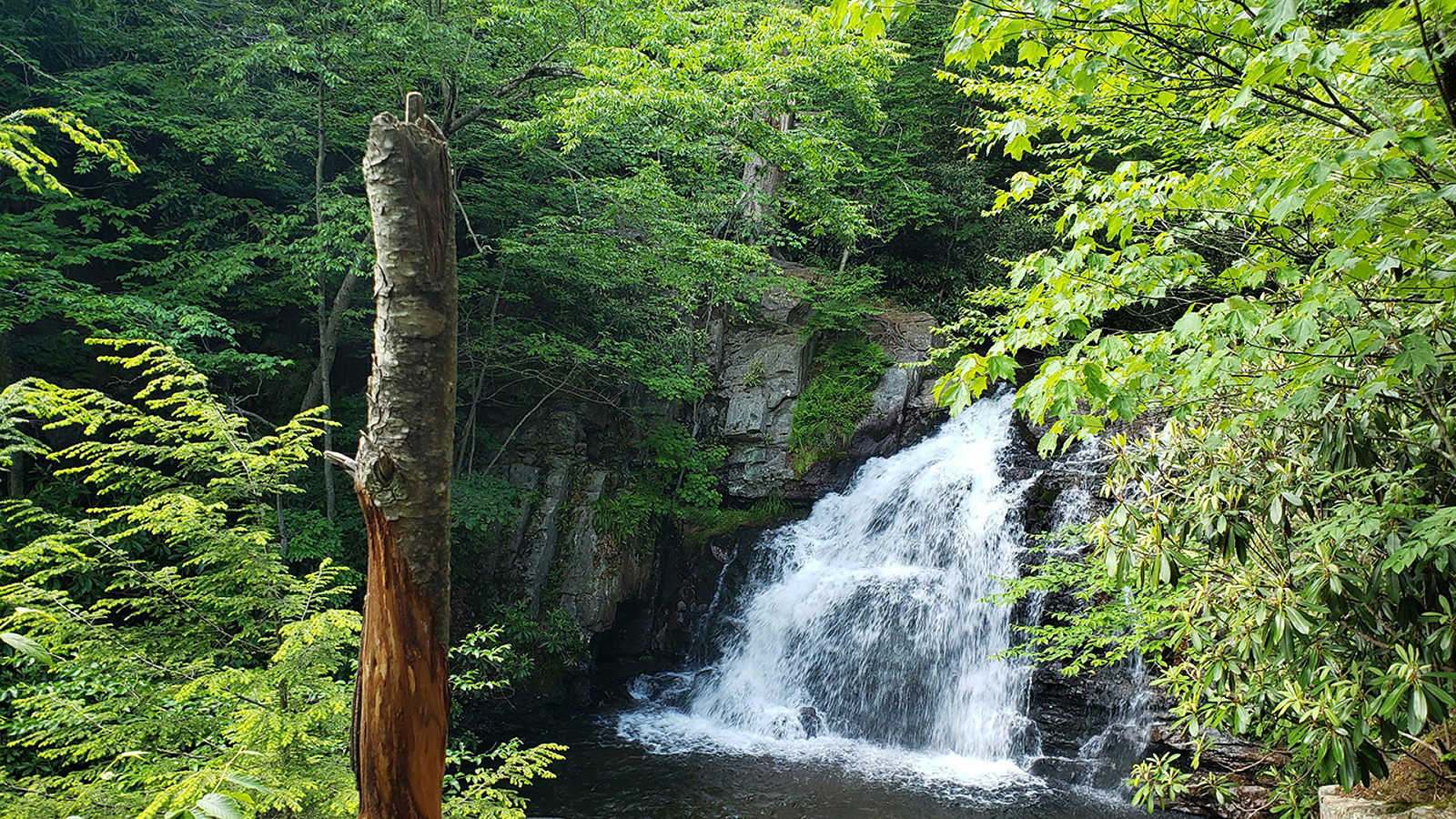
Hawk Falls is a compact waterfall hike in Hickory Run State Park near White Haven, Pennsylvania. The yellow-blazed loop is only 0.6 mile, but Pennsylvania DCNR rates it “more difficult,” and the approach has no trailhead amenities. The reward is a natural 25-foot waterfall framed by hemlock, rhododendron, and dark rock. The limitation is equally clear: swimming is prohibited, wet stone is slippery, and a camera does not justify leaving the established route. This guide focuses on a safe hike and realistic waterfall photography.
Hawk Falls quick facts
- Operator
- Pennsylvania Department of Conservation and Natural Resources
- Trail
- Hawk Falls Trail, yellow blazes
- Distance
- 0.6-mile loop
- Difficulty
- More difficult
- Waterfall
- Natural 25-foot drop
- Trailhead facilities
- None
- Important rule
- Swimming is prohibited at Hawk Falls
- Facts checked
- July 28, 2026
What should photographers expect on the trail?
The short mileage can make Hawk Falls sound easier than it is. DCNR’s official hiking page lists the loop as more difficult and notes that the trailhead has no amenities. Carry water, use footwear that grips damp roots and stone, and leave enough time to return before dark. A lightweight camera kit is more useful here than a full bag that changes your balance on uneven ground.
Stay on the established route and treat the base area as a shared viewpoint, not a studio. Keep tripod legs out of the walking line, avoid climbing slick rock for a lower angle, and never enter the pool. The waterfall is strong enough compositionally without manufacturing risk.
Which light and lens choices work?
Hawk Falls sits in a wooded setting, so bright overcast conditions often produce more manageable contrast than hard midday sun. A normal zoom in the 24–70mm range can handle the full drop and tighter rock-and-water studies. A phone’s standard lens is usually the cleanest choice; the ultra-wide lens can exaggerate foreground rock and shrink the waterfall. A circular polarizer can reduce glare on wet leaves, but rotate it carefully so the water does not lose every reflection.
For visible water texture, stabilize the camera and begin with a modest shutter speed instead of automatically reaching for a multi-second exposure. Fast water and small branches can become mushy when the exposure is too long. After rain, stronger flow may look appealing, but saturated soil, slick roots, and swollen streams raise the hiking risk.
What rules shape the session?
Hickory Run is a state park, so posted closures and Pennsylvania state-park rules control the visit. Check the official park page before leaving home. Do not represent a drone flight as part of a routine Hawk Falls visit: Pennsylvania state parks allow unmanned aircraft only at designated flying sites, and Hawk Falls is not presented as one. Ground-level photography is the appropriate default.
What pairs well with Hawk Falls?
Keep the day geographically tight. Boulder Field offers a radically different wide-angle subject within Hickory Run State Park, while the park’s other trails provide forest details without another long drive. For a larger Pennsylvania waterfall assignment, compare the Ricketts Glen Falls Trail guide. For a river overlook rather than a cascade, use the Chickies Rock photography guide.
Official sources and updates
- Pennsylvania DCNR: Hickory Run hiking and Hawk Falls Trail
- Pennsylvania DCNR: Hickory Run State Park
- Pennsylvania DCNR: state-park rules and regulations
Carry the regional thread: browse PA Falls Here gear after the route is planned.
\n